Silage Making
How to Check Silage Quality: Smell, Colour, pH & Moisture
Not all silage is the same. Two bales can look alike from the outside and feed completely differently. Poor silage wastes money at best, and at worst makes animals sick or cuts milk. The good news is that you do not need a laboratory to judge most of it — five checks at the bale tell you almost everything.
Check 1 · Smell. Good corn silage smells pleasantly sour and slightly sweet or fruity, like a mild pickle — that is lactic acid, the sign of a clean fermentation. A sharp, strong vinegar smell means too much acetic acid; animals may eat less of it. A rancid-butter or foul smell means butyric acid from a bad, usually too-wet fermentation — this silage loses nutrients and animals dislike it. An ammonia or fishy smell means protein has broken down. A burnt-sugar, caramel or tobacco smell means the silage overheated because air got in during filling or storage; much of its protein has been damaged.
Check 2 · Colour. Good corn silage is olive-green to yellow-brown and looks much like the fresh crop, just darker. Dark brown or black silage has overheated. Slimy dark green silage with a bad smell was too wet. Patches of white, blue-green, pink or black mould mean air has entered. Throw mouldy portions away — do not mix them into the feed. Moulds can produce toxins that harm animal health and fertility and can pass into milk.
Check 3 · Feel and moisture. Squeeze a fist full of silage for about 30 seconds and open your hand. If water drips out, it is too wet (above about 70% moisture) and likely to ferment badly. If the ball holds its shape and your palm is damp but not dripping, the moisture is about right. If it falls apart immediately and feels dry and springy, it was harvested too dry and probably was not packed tightly enough. Good corn silage is made at 30–35% dry matter — 65–70% moisture.
Check 4 · pH. Well-fermented corn silage has a pH between 3.8 and 4.2. You can test this cheaply: mix a handful of silage with an equal amount of clean or distilled water, let it stand for 15–20 minutes, and dip a pH strip into the liquid. Above about 4.5 suggests incomplete fermentation or air damage. Every Richnest bale is made to reach pH 3.8–4.2.
Check 5 · Heat. Push your hand into the opened face of the bale or pit. Good silage feels cool, close to the air temperature. Silage that feels warm or steams is being attacked by yeasts and moulds because air has got in — this is where most feed is lost after opening. Feed warm silage quickly or discard the damaged part, and next time finish open bales faster and keep the face covered.
Look at the chop and the grain. Pieces should be short and even — about 8–12 mm for corn — without long strings of stalk. Long pieces trap air and ferment unevenly, and animals sort them out and leave them. Grain should be visible in the silage; a crop harvested at the milk-dough stage gives the best mix of energy from the grain and digestible fibre from the plant.
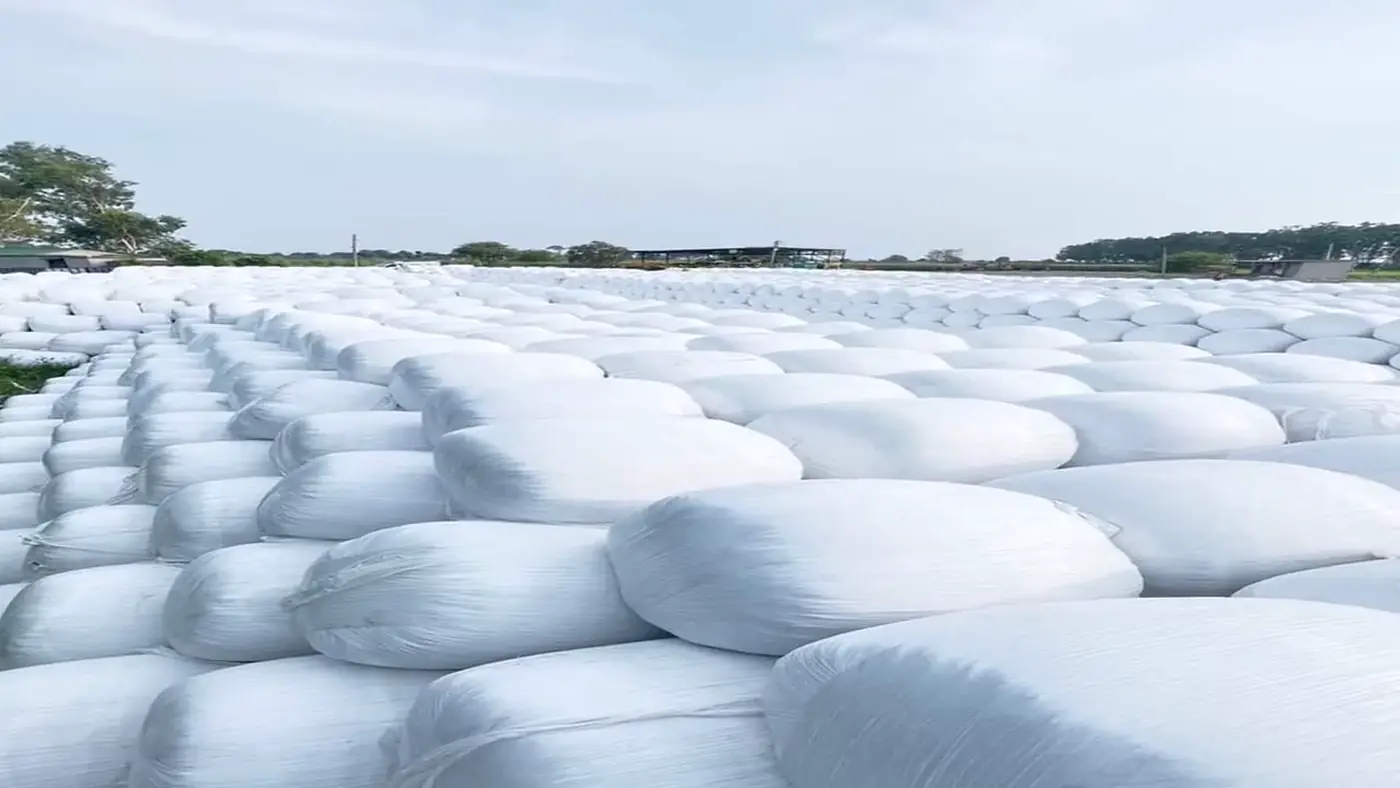
Check the package. For bales, the wrap should be tight, with no holes, tears or loose ends. A bale that feels hollow or soft in patches, or film that has puffed up, has probably let air in. Store bales in shade, off wet ground and away from rats and birds, and repair any small hole with silage tape immediately.
What about a lab test? For large dairies or when buying in bulk, a feed laboratory can report dry matter, crude protein, fibre (NDF and ADF), starch and energy. These numbers let a nutritionist balance the ration exactly. For most small and medium farmers, the five checks above — plus watching the milk and the dung — are enough to judge a supplier.
Questions to ask any silage supplier: What dry matter was it harvested at? What is the pH? How many layers is the wrap, and how long will a sealed bale keep? How long has it fermented before delivery? Can I see a bale opened? A good supplier will answer all of these without hesitation.
At Richnest, every bale is harvested at 30–35% dry matter, chopped to 8–12 mm, compacted and sealed in 9-layer high-barrier film, and fermented to pH 3.8–4.2 so it keeps for 12+ months while sealed. Order a trial lot on WhatsApp, open a bale, and run these five checks yourself.